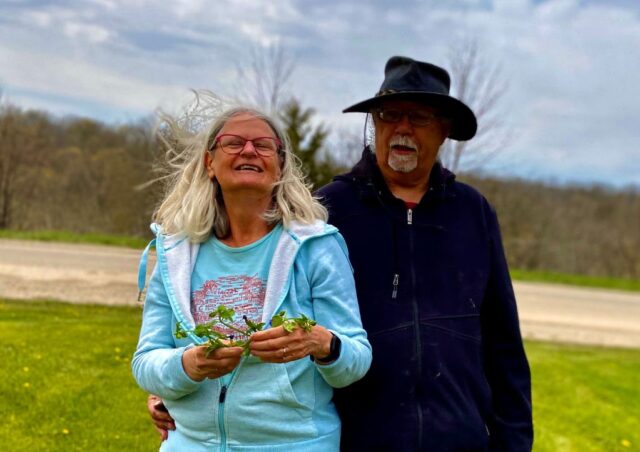
Anna and Chris Hendry
Chris and I have been married since 1973, being high school sweethearts. In 2007, the same year we became grandparents, he was diagnosed with Parkinson’s Disease, and we also became “care-partners”. For the most part, we carried on with life as it was before the diagnosis; I was in denial and Chris refused to let IT take over his life.
Eventually, Chris came to realize that the progression of PD was making it impossible for him to work effectively and he decided to join me in retirement in June of 2019. We looked forward to a retirement where we could do what we enjoyed, go where we wanted and spend time with our family.
That version of our retirement was short-lived. In late 2020, his PD symptoms began to include hallucinations, delusions, disorientation, balance issues and sleep disorders. Unfortunately, his health issues were not limited to Parkinson’s and in 2023, after experiencing severe back pain, he was diagnosed with Lumbar Spinal Stenosis.
As a “caregiver,” I was now doing all the things essential to carrying on with day to day life, but the hardest part was the added need to assist him with simple tasks such as eating his meals, getting dressed, getting in and out of bed or chairs; as well as the most difficult task of helping him through his anxiety, hallucinations and confusion.
Following back surgery in April 2025, to correct the stenosis, instead of recovering and improving, his health rapidly declined and in June 2025 he was hospitalized. He suddenly could no longer stand or walk. Eventually, we received the diagnosis of Chronic Inflammatory Demyelinating Polyneuropathy (CIDP for short), being an autoimmune disease which caused him to lose functional use of his hands and feet. Recovery from this disease is a lengthy process but it is not guaranteed. After months of being in the hospital, he was moved to Sprucedale Care Centre, with the hope he would recover function and mobility.
As a “caregiver” I am no longer needed for his daily needs. I continue to spend several hours each day with him.
As a “caregiver” my own life has been thrown into a survival mode where it is reactive to everything that is happening with him.
As a “caregiver” I have been unable to create a routine around everything that is required. I am just going through the motions with each day bringing new challenges. I feel I have no control over my life.
As a “caregiver” I have my moments when I want to give up, when I think I can’t do this anymore, when my exhaustion and anxiety are overwhelming.
As a “caregiver” I continue do what is required, when it is required, in the best way I can. I tell myself “pull up my big girl panties and carry on”.
I hate that he asks almost every day if he can come home with me.
I hate that I am unable to give him the care he needs at home.
I hate that I am alone at home every night.
I hate knowing he is lonely, confused and disoriented.
I hate that this isn’t what our retirement was supposed to be.
I hate that I always feel like I’m not doing enough or doing it wrong.
I hate that my optimism for his recovery is waning.
I find it difficult to ask for help, but I am not alone in our journey. Our three adult children and their life partners are also caregivers. I could not have come this far without their love, support and thoughtfulness. Their visits with Chris are essential for his mental health, reminding him of how much he means to all of us.
I also have to thank our extended families and friends for their care, both emotionally and financially. Their support and efforts through all of this are invaluable.
I am forever grateful to everyone in our lives.
We don’t have to do it all alone. We don’t have to do it perfectly. Please remember to use whatever resources that are available to you in the care of your loved one, as well as yourself.